
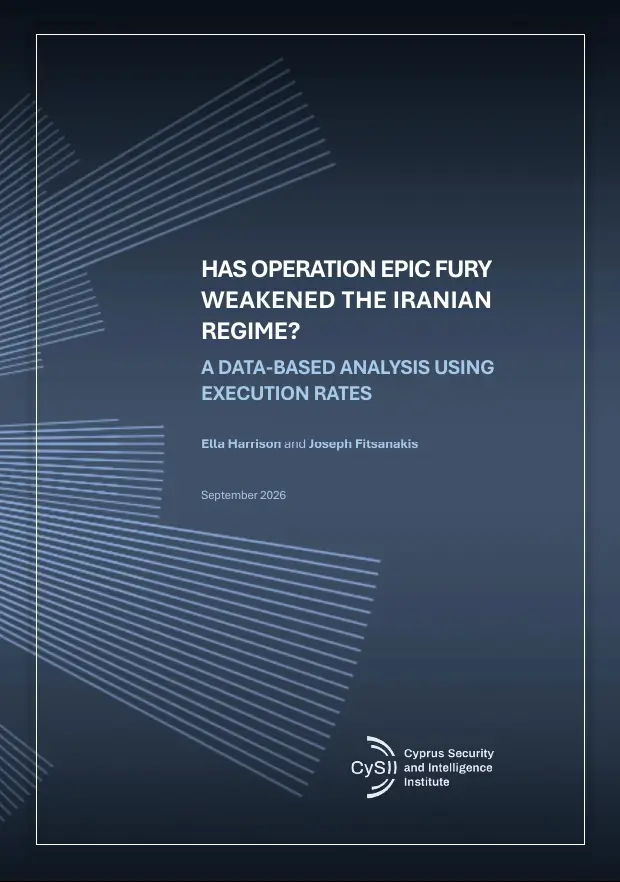
Present-day Iran is arguably the most prolific state executioner state in the world. It currently holds the
unenviable record of executing the largest number of people per capita globally. Historical data show that
Iran’s rate of political- and dissident-linked executions, as opposed to executions for criminal offenses,
historically spirals when the regime’s authority is challenged by civil society. This paper assembles all
available data about the rate of executions in the lead-up to Operation EPIC FURY, which began in February
28, 2026, and compares them with the rate of executions following the outbreak of war. The purpose of the
analysis is to assess whether an increase in the rate and intensity of executions points toward a deepening
weakness at the heart of regime—such as internal fragmentation and disarray—which could foreshadow a
period of wider sociopolitical instability. The execution data are therefore examined as a measurable
projection of the regime’s power and absolute control over civil society. Our concluding formulation is that
the evidence does not support a distinct choice between intense panic and intense confidence among
regime circles. Rather, what it points to is that the regime remains strong enough to kill at a mass scale, yet
not secure enough to make killing unnecessary. We argue, therefore, that the Islamic Republic’s execution
policy during wartime is best understood as a form of deliberate coercion deployed from a position of
institutional strength in response to a condition of relative—but not critical—political weakness.
More in Publications
Present-day Iran is arguably the most prolific state executioner state in the world. It currently holds the
unenviable record of executing the largest number of people per capita globally. Historical data show that
Iran’s rate of political- and dissident-linked executions, as opposed to executions for criminal offenses,
historically spirals when the regime’s authority is challenged by civil society. This paper assembles all
available data about the rate of executions in the lead-up to Operation EPIC FURY, which began in February
28, 2026, and compares them with the rate of executions following the outbreak of war. The purpose of the
analysis is to assess whether an increase in the rate and intensity of executions points toward a deepening
weakness at the heart of regime—such as internal fragmentation and disarray—which could foreshadow a
period of wider sociopolitical instability. The execution data are therefore examined as a measurable
projection of the regime’s power and absolute control over civil society. Our concluding formulation is that
the evidence does not support a distinct choice between intense panic and intense confidence among
regime circles. Rather, what it points to is that the regime remains strong enough to kill at a mass scale, yet
not secure enough to make killing unnecessary. We argue, therefore, that the Islamic Republic’s execution
policy during wartime is best understood as a form of deliberate coercion deployed from a position of
institutional strength in response to a condition of relative—but not critical—political weakness.